
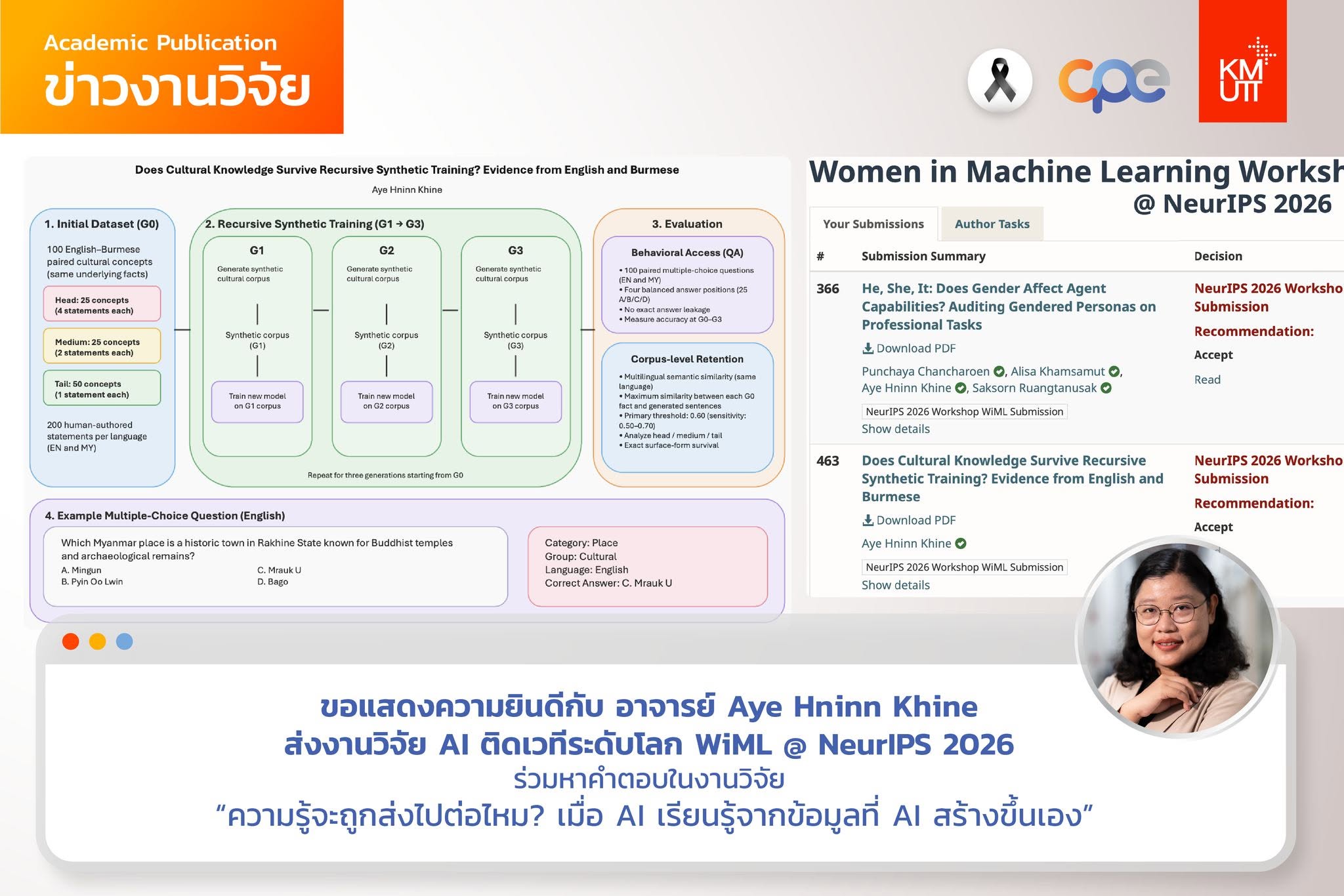
As AI models increasingly learn from synthetic data generated by previous models, an important question arises: Can culturally specific knowledge survive repeated cycles of AI-generated training, particularly in low-resource languages such as Burmese?
Dr. Aye Hninn Khine from the Computer Engineering Department at King Mongkut’s University of Technology Thonburi (KMUTT) has had her paper, “Does Cultural Knowledge Survive Recursive Synthetic Training? Evidence from English and Burmese,” accepted for presentation at the Women in Machine Learning Workshop (WiML) 2026, co-located with NeurIPS 2026, an international conference on machine learning.
Investigating Cultural Knowledge Through Recursive Synthetic Training
The study investigates how cultural knowledge changes as AI models are repeatedly trained on synthetic data generated by preceding models, comparing English and Burmese.
The researchers began with 100 paired cultural knowledge items in English and Burmese, forming the initial dataset (G0). A model then generated a new dataset (G1), which was used to train a subsequent model to generate G2, followed by G3. At each generation, the model relied on data produced by the preceding generation rather than directly accessing the original facts.
The study evaluated two aspects of knowledge retention: question-answering (QA) accuracy and semantic similarity between the generated text and the original facts.
Key Findings: Textual Similarity Does Not Guarantee Knowledge Retention
The results showed that QA accuracy declined in both languages. English accuracy dropped from 61% to 54%, while Burmese accuracy decreased from 48% to 44%.
However, semantic similarity revealed a different pattern. By the final generation, Burmese-generated text retained a higher semantic similarity to the original facts than English-generated text, at 73% compared with 60%.
These findings highlight an important distinction: generated text may remain semantically similar to its source even as a model becomes less accurate at answering questions about the underlying knowledge. Evaluating synthetic data therefore requires more than measuring textual or semantic similarity; it must also assess whether models can effectively use the knowledge they learn.
Implications for AI in Low-Resource Languages
This research raises important considerations for developing AI models that increasingly rely on synthetic training data, particularly for languages with limited available resources. In such settings, culturally specific knowledge may be underrepresented in training datasets, making its preservation an important research challenge.
The findings underscore the need for evaluation methods that examine not only whether generated content resembles the original data, but also whether the knowledge remains accessible and useful to the model.
The Computer Engineering Department at KMUTT congratulates Dr. Aye Hninn Khine on this research achievement and its acceptance at an international academic workshop. The department continues to support research that advances understanding of AI, data quality, model learning, and linguistic and cultural diversity.